Wednesday, January 28, 2015

Thursday, January 22, 2015
Sunday, January 18, 2015
Creating Lessons for Global Competence / ED 716 / Week 3 Response
Mansilla and Jackson argue that "globally competent students are able to investigate the world by identifying an issue, generating a question, and explaining the significance of locally, regionally, and globally focused researchable questions."
Thinking ahead to the next month of school, how might you begin to incorporate this into an upcoming learning opportunity?
This week’s reading reinforce the importance of creating globally competent students. As a high school English teacher, I’m lucky because a lot of literature lends itself to having students question, analyze and connect topics to the real world. In my next unit I hope to give students the opportunity to increase their global awareness and to research an issue of significance.
My sophomores will soon begin reading the book, Night, Elie Wiesel’s memoir describing his experiences in Auschwitz. As we read the book, we will supplement our background knowledge by reading articles about the Holocaust. In addition, we will study other issues of genocide and human rights abuses, both in the past and the present. I have also organized a field trip to Hartford Stage to see the production of The Pianist of Willesden Lane, which, according to the Hartford Stage website, “tells the story of a young Jewish musician who was sent from Nazi-ruled Vienna to the relative safety of London during the blitzkrieg.” The show promises to be inspirational and will provide students with an alternate perspective of survival during a horrific time. During the unit, we will discuss Wiesel’s purpose in writing the memoir; he believes people must be aware of injustice and be prepared to take action to prevent it.
As a culminating project, students will choose an organization that works to “improve the quality of life.” They will research the mission of the organization, what the organization is doing to address the problem, its effectiveness and how they can get involved. Topics may cover a multitude of issues including health, hunger, clean water, women’s and children’s rights, gender issues, housing, political equality, and various human rights abuses. I have done a similar project in the past and just a few of the organizations students have researched include: Partners in Health, Amnesty International, Habitat for Humanity, the United Nations, the Peace Corps, and even local food banks and charities. Presentations will be shared with the class. In the past, students have been extremely engaged; many become passionate about the causes they research. I hope that a project like this helps students to not only increase awareness, but to think critically about the problems, see from others’ perspectives and be prepared to take action in some way.
The Power of Service Learning / ED 716 Response / Week 3
In many school districts, service learning projects are a requirement for graduation. However, these types of projects often emphasize the need to help those who may be construed as "lesser" than ourselves.
How do you see service-learning as an educational vehicle for global competence?
I believe that service learning can be a very useful vehicle in educating for global competence. However, I believe that we must be careful not to approach it as a “have” vs the “have-not” type of intervention. Service learning shouldn’t be just something to put on a resume. Any type of service learning should be viewed from a standpoint of community responsibility. We are all in this together, and we should do what we can to improve the quality of life for the community as a whole and for everyone who is a part of it.
My school does not have a specific service learning requirement for graduation, but students are required to take civics which offers opportunities for community service. Also, in order to be inducted into the National Honor Society, students must have community service hours. The school has various clubs, such as InterAct which focus on service. Another opportunity exists for students to participate in the annual United Way Day of Caring. Students go out into the community to work on various projects such as painting cabins at the Girl Scout Camp, or clearing trails at the Nature Center. I believe that service projects help students to think beyond themselves. Creating an understanding that students have a responsibility to their local community is a necessary first step in creating students who are globally competent.
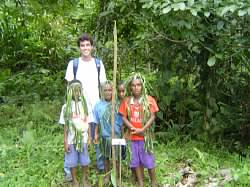
Successful service learning is invaluable. I think of my son, who participated in several Habitat for Humanity projects while in college. He went on several domestic trips during college, and after graduation he was part of a Habitat project in Papua, New Guinea. He did a great deal of fundraising to go to New Guinea, and he spent a month there, building a house for a family. Afterwards, he told me that the experience was life changing for him. It gave him a perspective on happiness and what was important in life that he never would have had before. He saw that people who had less in the way of material goods were not “lesser” in any way, shape or form. He came away in awe of how happy people can be without any of the conveniences we consider to be necessities of life. He came away with a deep respect for a culture that was distinctly from his own.


As Veronica Boix and Anthony Jackson say in the book, Mastering Global Literacy, globally competent students must be able to “recognize perspectives (others’ and one’s own)” (p. 10). They also must have “the capacity to communicate ideas effectively across diverse audiences” (p. 10). “Investigating the world and taking action are of no lesser value” (p. 10). Service learning affords individuals the chance to understand issues, broaden perspectives, communicate across cultures, and take action. What could be more important?
Citations:
Boix, V., & Jackson, A. (2014). Educating for Global Competence: Redefining Learning for an Interconnected World. In Mastering Global Literacy (pp. 5-27). Bloomington: Solution Tree.
Saturday, January 17, 2015
Thursday, January 15, 2015
Distance Learning / Educational Theories / Response / Week 2: ED 722
Response to "Foundations of Educational Theory for Online Learning" by Mohammed Ally and "Learning Theory and Online Course Design" by Jennifer Lewis.
The argument is made that it is not just the incorporation of technology in pedagogy that facilitates learning, but it is instead the design of the environment and the interactions and types of connections that the technology affords. Do you agree with this statement? Why or why not? How will you design your environment considering these concepts and the theories discussed?
After reading the article and watching the video, I believe that all of the learning theories described have some merit. Effective lesson design for online learning may contain elements of behaviorism, cognitivism, constructivism and sometimes connectivism. I agree that the design of the environment, the interactions and the types of connections the technology affords all contribute to successful online learning.
As Ally says in his article, “Behaviorists' strategies can be used to teach the “what” (facts), cognitive strategies can be used to teach the “how” (processes and principles), and constructivist strategies can be used to teach the “why” (higher level thinking that promotes personal meaning and situated and contextual learning). The theory of connectivism may apply when students learn a great deal from each other, particularly in MOOC’s.
When I analyze the way many high school lessons are created, I see many elements of behaviorism. The behaviorist theory espouses that learners should be told the specific outcomes which are expected of them. It is the job of the instructor to provide and sequence the materials to promote learning and to provide feedback along the way. For the most part, learning is passive. As Ally says, behaviorist strategies are a great way for kids to learn facts. Educationally, it is considered good practice to explain to the students what outcomes are expected of them, hence the extensive use of rubrics. However, effective learning requires more than a passive acceptance of knowledge provided by the instructor via technology.
Cognitivism is a theory based on an understanding of how a learner acquires, processes and stores information. The way in which information is presented affects the acquisition of knowledge. Information can’t be introduced randomly to students; effective instruction requires teachers to get the learner’s attention, state clear objectives, stimulate prior learning, and scaffold information. In addition, the appearance of information on the screen is critical. Placement, color, headings and graphics can facilitate understanding of new information. If the teacher is creating or choosing materials to use, the appearance and organization of the material is important. Teachers also should be prepared to provide students with graphic organizers, questions, and conceptual models to maximize understanding. Cognitive theory implies a respect for individual differences, thus learning activities should be varied to appeal to different learning styles. Effective teachers provide motivation and explain the relevance of the learning. When teachers understand the principles of cognitivism, students can reap the benefits.
Proponents of constructivism view knowledge differently than those who subscribe to behaviorism or cognitivism. According to constructionists, knowledge doesn’t exist outside of the person, but is “the individual learner’s interpretation and processing of what is received through the senses that creates knowledge” (Ally). Learners become active participants and the instructor becomes a facilitator. Learning becomes collaborative and cooperative. A great deal of online learning contains elements of constructivism. In order for learning to be effective, students must interact with content, with other learners, and with the instructor to create personal meaning. In distance learning, the teacher is helping the students on a journey of “guided discovery “ (Ally). Frequently students learn as much from each other as they do from the instructor. While the instructor guides, learning is more self-directed than it is in either behaviorism or cognitivism.
Finally, connectivism is a newer theory which applies largely to online learning. Connectivists believe that knowledge is built through the connections that individuals have access to. It’s a type of collective intelligence. MOOC’s are the perfect example; the more people are connected, the smarter they are (Lewis). Under the connectivism theory, the instructor’s main job is to prepare and scaffold the materials. The students learn mostly from each other. As a result, the amount of learning is often directly related to the mix of participants in the class. For the most part, connectivism does not play a large role in high school education. I believe that students need more guidance from a teacher than is implied in the connectivist model.
When I analyze my teaching, I find that I utilize strategies from behaviorism, cognitivism and constructivism, whether I’m using technology or not. The strategies described in the cognitive theory are very helpful to students. I frequently provide activities to access prior knowledge and create graphic organizers to help students organize information. Based on this theory, I will also pay more attention to the websites I choose for students, increasing my awareness of the layout and organization of sites. I also see myself using principles from constructivism. I’m a firm believer in making students active learners. Students frequently work in cooperative groups to investigate, problem solve, synthesize and evaluate information. I want to continue trying to step back and become more of a facilitator, letting kids direct their own learning. As I’ve increased the amount of technology in my classroom this year, I’m finding that students are becoming adept at driving their own learning.
Good teaching and effective learning necessitate a mix of strategies. The bottom line is that I want to motivate my students by designing activities that are relevant and have real world applications. I want students to be active learners, but it’s also critical to provide appropriate materials, necessary support and opportunities to collaborate in order to maximize learning.
Monday, January 12, 2015
Multicultural Literacy and Global Awareness: Literacy in the Digital Age / Reflection p. 28-31
Literacy in the Digital Age: p. 28-31 / reflection
The reading identifies characteristics of multicultural literacy and global awareness. Although I had previous considered the terms fairly interchangeably, I see that there are subtle differences.
Being multiculturally literate involves an appreciation of other cultures. It requires sensitivity and an acceptance of similarities and differences. Multicultural literacy, according to the definition in the article is a lot about one’s attitude.
Global awareness is more knowledge based. It’s important to understand the ideologies of other cultures. We must stay current on the news and trends of the rest of the world. We must understand the depth of interconnectedness “historically, politically, economically, technologically, socially, linguistically, and ecologically” (p. 30).
The bottom line though, is that multicultural literacy and global awareness go hand in hand. We need awareness and knowledge to fully appreciate the diversity which exists among the cultures of the world. We are attempting to integrate global awareness and multicultural literacy in our schools but it’s a monumental task. The new Common Core based curriculum makes it a priority.
Subscribe to:
Posts (Atom)